Email: myemail@email.com
Request a quote
If it does not pass, it does not ship.

Every pump gets tested. Not a sample from the batch. Every single one.

A lot of factories test one pump from a batch and call it good. We do not. Every pump that leaves this building has been on a test bench for at least 20 minutes — some run for over an hour. The test report goes in the crate. You get a copy by email. If the pump does not hit its numbers, it goes back to the bench. It does not go into a crate and it does not get shipped and we do not hope you will not notice.
100%
Pumps individually tested
8
Test benches
2018
ISO 9001 certified since
0
Untested pumps shipped
Five measurements. Every pump. Every time.

What happens on the test bench

Every pump — rotary vane, piston, claw, screw, roots — runs through the same five-point test. The specific pass/fail thresholds depend on the model, but the test procedure is identical. We do not skip tests because it is Friday afternoon.

1. Ultimate Vacuum

We measure the deepest vacuum the pump can pull with the inlet closed. For rotary vane pumps, this is typically 0.5-1.5 Pa. For claw pumps, around 20 Pa. For roots boosters, we measure with a backing pump in the loop. We use a calibrated Pirani gauge plus a capacitance manometer for cross-verification. The pump must hit its rated ultimate within a specified time window — usually 20-30 minutes from cold start. If it does not, we look for leaks, check the oil, check the seals, and rerun. If it still fails, it gets torn down.

2. Pumping Speed

We measure flow rate (m³/h or L/s) at the rated inlet pressure using a mass flow meter. This is the number that tells you how fast your chamber gets pumped down. We test at multiple pressure points — not just the rated point — to generate a rough speed curve. If a pump's speed is off by more than 5% from the rated value, we investigate. Usually it is a minor assembly issue. Occasionally it is a machining tolerance problem. Either way, it gets fixed before the pump ships.

3. Motor Current

We measure the motor's current draw under load. If it is too high, something is binding — a misaligned rotor, a tight bearing, an assembly error. If it is too low, the pump might not be compressing properly — perhaps a vane is stuck or a clearance is too large. We set upper and lower limits for each model based on historical data. Readings outside those limits trigger a teardown.


4. Noise Level

Measured at 1 meter from the pump in a semi-anechoic test enclosure. We measure dB(A) at the rated operating point. Rotary vane pumps typically run 48-62 dB(A) depending on size. Claw pumps are louder — 65-78 dB(A). If the noise is above the specification limit, it is usually a balance issue or a worn bearing. We rebalance the rotor or replace the bearing and retest. Noise complaints are one of the top reasons pumps get returned in this industry. We would rather catch it on our bench than have you catch it in your lab.

5. Vibration

Measured with an accelerometer mounted on the pump housing. We measure RMS velocity in mm/s at the bearing positions. Limits are set per model. Excessive vibration usually indicates a balance problem, a bent shaft, or a coupling misalignment. Vibration does not just annoy your operators — it kills bearings and shortens pump life. If the vibration reading is above the limit, the pump gets torn down and the rotating assembly gets rechecked on the dynamic balancer.


You get the data. Not a promise.

The test report ships with your pump.

Every pump leaves our factory with a printed test report inside the crate. The report shows:
Pump model and serial number
Date of manufacture and test date
Technician name who performed the test
Ultimate vacuum achieved (Pa)
Pumping speed at rated pressure (m³/h or L/s)
Motor current draw (A)
Noise level (dB(A) at 1 meter)
Vibration reading (mm/s RMS)
Oil type and quantity filled
Pass/fail status for each parameter
Overall pump status
We also email you a PDF copy before the pump ships. If you are an OEM partner, the report uses your company template with your logo. The numbers are the same either way.
The quality system behind the tests

ISO 9001:2015. Certified since 2018. Audited every year.

Incoming Material Inspection

Raw materials, castings, bearings, seals, motors — everything that enters the factory gets inspected before it reaches the production floor. We have a sampling plan (AQL 1.0 for critical dimensions, AQL 2.5 for non-critical) and a documented procedure for what happens when a batch fails. We have rejected entire shipments of cast iron for porosity. We have sent back motors that did not meet nameplate efficiency. The supplier does not like it. The pump does.

In-Process Inspection

During machining and assembly, QC technicians perform dimensional checks at defined stages. Critical dimensions — rotor bore diameter, shaft runout, end plate flatness — are checked on every part, not sampled. Non-critical dimensions are sampled per the control plan. If a dimension is trending toward the tolerance limit, the production team gets notified before it goes out of spec.


Nonconformance & CAPA

When something fails — a test, an inspection, a customer complaint — we open a nonconformance report. Root cause analysis gets done. Corrective action gets implemented. Follow-up verification happens within 30 days. This is not a paperwork exercise. We track defect categories and look for patterns. If the same issue appears twice in a quarter, the engineering team gets involved.


Calibration

All measurement equipment — vacuum gauges, flow meters, power analyzers, sound level meters, accelerometers, micrometers, calipers, CMM — gets calibrated annually by an external accredited lab. Calibration certificates are available on request. If a gauge drifts between calibrations, we have a procedure for that — it gets tagged out of service and all pumps tested with it since the last calibration check get reviewed. We have only had to do this once. It was not fun. It was correct.

Traceability

Every pump has a unique serial number. That serial number links to: the date of manufacture, the batch of raw materials, the CNC programs used, the assembly technician, the test technician, and the full test record. We can pull up the complete history of any pump by serial number, going back to 2021 for digital records and back to 2018 for paper records. If a pump fails in the field, we can trace backward to see if there is a pattern. We have used this to catch a supplier quality issue before the customer noticed.
When things go wrong. And they do.

Defect tracking and continuous improvement

We are not going to tell you we have zero defects. That would be a lie. We track every defect, analyze the cause, and fix the process. Here is what our defect tracking looks like in practice.

Internal defect rate

Roughly 2-3% of pumps fail initial testing and require rework before they ship. Most failures are minor: a slightly high noise reading, a vacuum that takes too long to stabilize, a current draw at the edge of the limit. About 0.5% are major failures that require a teardown. We track this monthly. If the rate trends upward, we investigate.


Customer return rate

Under 1% across all product lines over the last three years. When a pump comes back, we do a full failure analysis. The result gets shared with the customer whether or not it is a warranty claim. Common root causes we have found and fixed: inadequate rust prevention on sea freight shipments (added VCI packaging), rotor imbalance at high hours (changed balancing spec), and oil leakage during air freight at altitude (redesigned the breather plug).

Supplier quality

We rate our suppliers quarterly on delivery performance and quality. Bearings and seals are our highest-risk purchased parts — a bad bearing can kill a pump in weeks. We have dropped two bearing suppliers in the last five years for quality issues. We now dual-source bearings from a Japanese and a German manufacturer. It costs more. The failure rate dropped from 0.4% to under 0.05%. Worth it.

The test area

Where the numbers come from

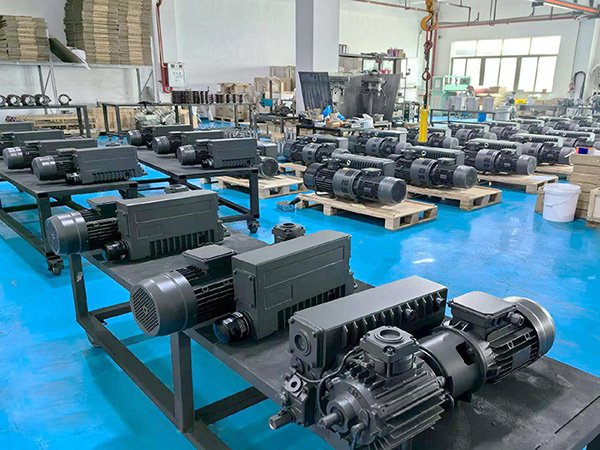
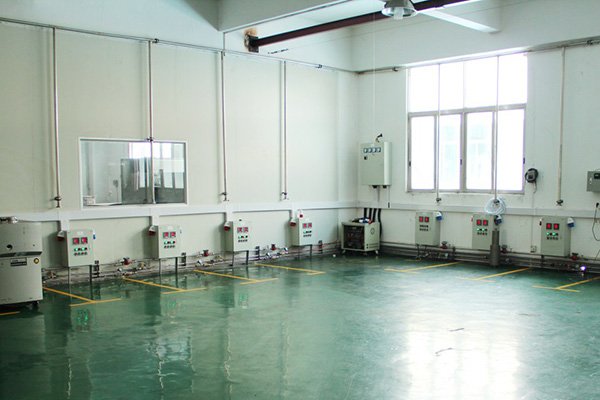
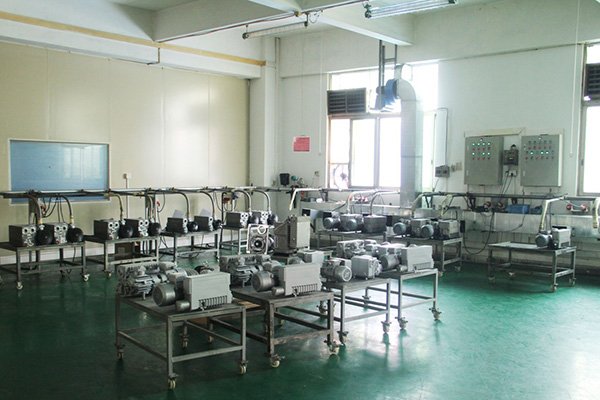
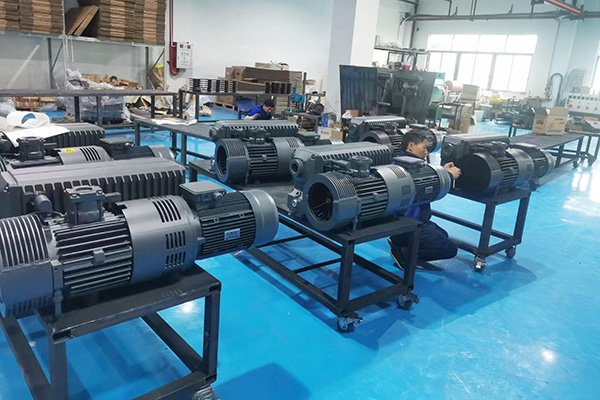
Eight test benches in a row. Each bench is sound-insulated with acoustic foam panels. The benches are numbered 1 through 8. Bench 4 is the one we use for screw pumps — it has the largest vacuum chamber and the highest-capacity backing pump.
Calibrated Pirani and capacitance manometer gauges. We cross-check readings between gauge types. If the Pirani says 0.8 Pa and the capacitance manometer says 1.2 Pa, we stop testing and recalibrate. Gauge disagreement is the most common source of false failures.
The data logging rack. Every test bench feeds into a central system that records the vacuum curve, speed, current, noise, and vibration in real time. Test records are archived digitally with the pump serial number. Backup is weekly.

After the test. Before the crate.

Pre-shipment checks

Testing is not the last step. Before the pump goes into its crate, we do a final visual inspection:
All fasteners checked for torque. We use a paint mark system — if the paint mark on a bolt head does not align with the mark on the housing, the bolt has moved and gets retorqued.
Oil level verified. Sight glass checked. If the pump is shipped dry (some OEM partners prefer this), the oil drain plug gets a tamper-evident seal.
Inlet and exhaust ports capped or plugged. Keeps debris out during shipping.
Serial plate verified against the order. Model number, serial number, voltage, date. Wrong serial plate is a surprisingly common error in this industry. We double-check.
Accessories packed per the order: oil bottle, spare vanes, inlet filter, manual, test report. All items checked against the packing list.
Crate inspected for structural integrity. We build our own crates. We stopped using third-party crating after a shipment to Brazil looked like it had been used as a soccer ball.
What happens when a pump has a problem

Warranty. 12 months. Straightforward.

What is covered

Manufacturing defects. Material defects. Assembly errors. Anything that is our fault. Covers the pump and all GOFLEX-supplied accessories shipped with it. The warranty period starts from the date of shipment — not the date of arrival. We do this because sea freight can take 4-6 weeks and we do not think you should lose a month of warranty because the boat is slow.

What is not covered

Damage from misuse, abuse, or accident. Running the pump without oil. Pumping things the pump was not designed to pump. Modifications made without our approval. Normal wear items (vanes, seals, oil) after their expected service life. Forklift damage. Lightning strikes. We had a customer once claim warranty because a pump fell off a truck. We did not cover that one.

How claims work

You email us with the serial number and a description of the problem. Photos or video help. We assess within 24 hours. If it is a clear warranty issue, we ship replacement parts within 3 business days — or a complete replacement pump if the failure is major. If the failure cause is unclear, we may ask you to return the pump for analysis at our expense. We cover return shipping on confirmed warranty claims.

After warranty

We still support you. We stock parts for every model we have ever made — including discontinued ones. Spare parts orders ship within 3-5 business days. We do not charge an "expedited fee" for parts orders under warranty claim evaluation. If you need technical support diagnosing a problem on an out-of-warranty pump, we still take your call.
Quality questions we actually get

Quick answers

Do you really test every pump?

Yes. Every single pump runs through all five test points on one of our eight test benches. We have the data logs to prove it. You get a copy of the test report with the pump and by email. If you want, we can send you a photo of your specific pump on the test bench with the gauge readings visible. Some buyers ask for this. We are happy to do it.

How long does testing take per pump?

Small rotary vane pumps: 20-30 minutes. Larger screw and claw pumps: 45-90 minutes. Roots boosters: 30-60 minutes including setup with a backing pump. The limiting factor is how long it takes the pump to warm up and stabilize. We do not rush this.

What happens if a pump fails the test?

It gets tagged as failed and moved to a rework station. The test technician writes a brief description of what failed and at what reading. The assembly lead diagnoses the cause. Most failures are fixed within the same shift. The pump then goes back to the test bench for a full retest — not just the parameter that failed. If a pump fails twice, it gets a full teardown.

Can I get test data for pumps I ordered previously?

Yes. Send us the serial number and we will pull the test record from our archive. Digital records go back to 2021. Paper records go back to 2018. We can scan and email older records — it might take a day or two if they are in the file cabinets.

Is the test bench equipment calibrated?

Yes. All measurement equipment is calibrated annually by an external accredited laboratory. Calibration certificates are available on request. We also do internal cross-checks between benches quarterly to make sure bench-to-bench variation is not masking a problem.

How do I know the test report is real and not just filled in?

Our test reports include the serial number, date, time, and technician name. The digital records are timestamped in our logging system and cannot be edited after the fact. If you have a reason to doubt a specific report, ask us. We will pull the raw data log. We have nothing to hide on this — our defect rate is low enough that we do not need to fake test results.

What is your defect rate?

Internal: 2-3% of pumps fail initial testing and need rework before they ship. Customer returns: under 1% across all product lines over three years. These are real numbers, not marketing numbers. We track them monthly and we do not round down.

Want a vacuum pump that ships with its proof of performance?

Tell us what you need. We will quote within 24 hours and your test report ships in the crate.
Request a quote

GOFLEXPUMP

GOFLEX SUPPLY CHAIN CO.,LTD.
Dongguan, Guangdong, China
sales@goflexpump.com
ISO 9001:2015 | CE
Copyright © 2026 goflexpump.com. All Rights Reserved
arrow-right linkedin facebook pinterest youtube rss twitter instagram facebook-blank rss-blank linkedin-blank pinterest youtube twitter instagram